skip to main |
skip to sidebar
 It appears that my project of hand pollinating the miniature eggplant has been a success as the plant has quite a few miniature eggplant forming, and it continues to grow and bloom. I do not, however, have any idea of what I am going to do with these tiny eggplant.That said, I have come to the conclusion that the reason that I was not successful in growing eggplant in the greenhouse previously was my choice of variety. Apparently, the Florida Highbush plant I tried to grow required different environmental conditions in order for it to set fruit.To pollinate the flowers, in addition to shaking them, I inserted the tip of a small artist brush into the center of the flower and rotated it to transfer pollen from the stamens to the pistil

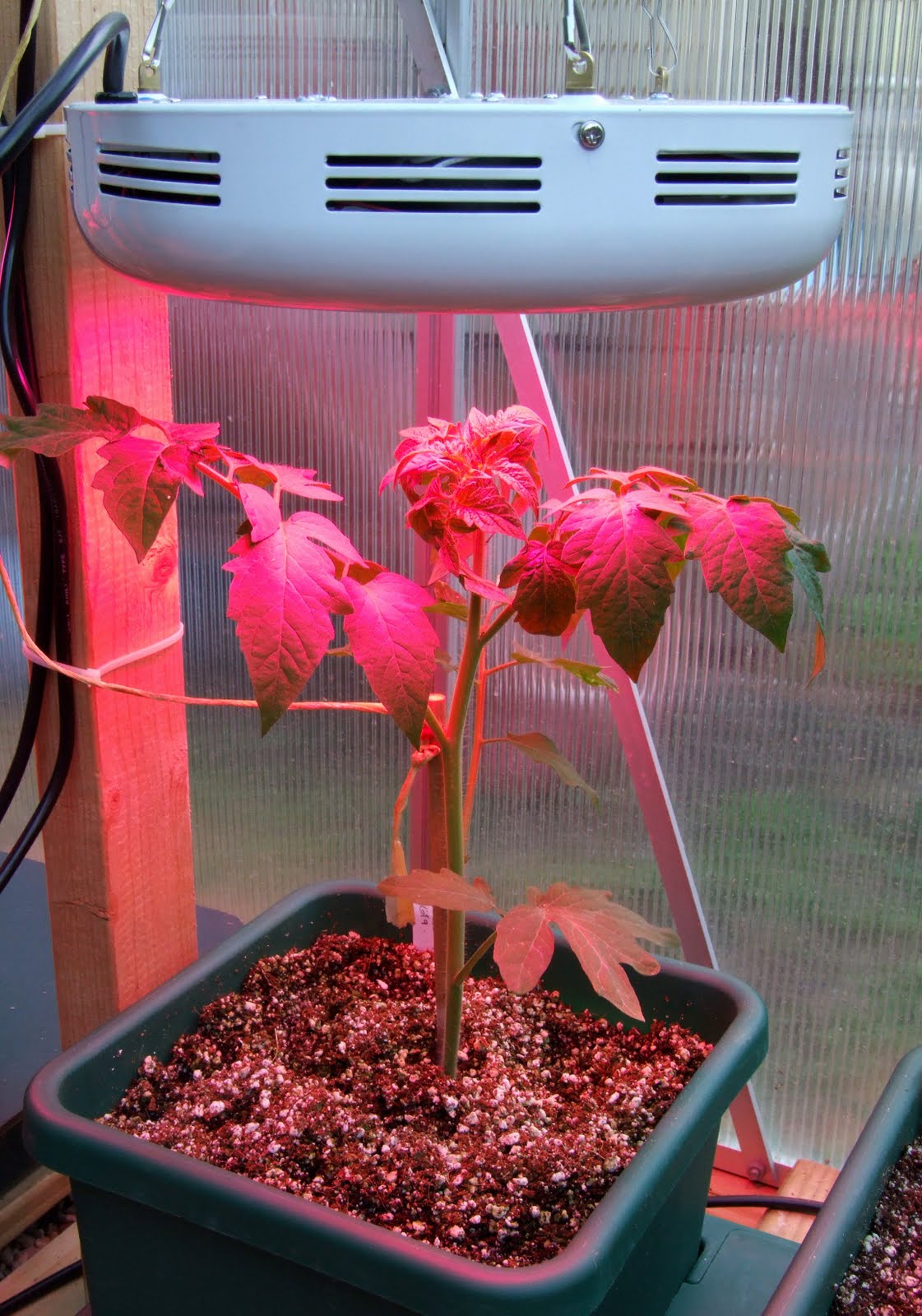
The title is borrowed from a song written for the 1955 musical Damn Yankees, however, in this case Lola is a variety of tomato, and what she wants is plenty of light.Territorial Seed Company writes this about this variety:
"80 days. Lola is an eye-catching charmer with veritably everything one could dream of in a tomato, plus the added benefit of an indoor cultivating variety. Big, plump, luscious fruit are lipstick red with a delightfully delicate flavor and absolutely divine aroma. The tomatoes develop a round, slightly squat shape, averaging a hefty 7-9 ounces each, and offer superior storability. Potato-leaf, indeterminate plants.F1, F2, V, ToMV"
The plant in the photo is receiving about six hours of supplemental lighting each day from a 90 watt LED. The reason for the supplemental lighting is because the plant, being shaded, is not receiving direct sunlight, and tomatoes love light.To really produce, tomatoes need at least 30,000 footcandles of light per day. My intent is that what the plant is lacking in intensity, I will supplement by increasing the duration of light it receives.

 Today, my assistant and I picked all of the small gherkin size fruit from the Little Leaf cucumbers in the greenhouse and started another batch of dill pickles.
We removed the plants and replaced them with two Little Leaf seedlings that I had started a few weeks ago. The plants that were replaced were still growing, however, I feel that they lose vigor and slow down after awhile. I guess it is like life; as you get older you slow down some.
The plants in the soil garden, started on the same day as the replaced plants, are now just beginning to really set fruit, so we will have a continuous supply for quite sometime. In mid-August, I will replace the greenhouse plants to try to grow cucumbers as late in the season as I can get away with it.
 When the Trust hybrid was approaching the peak of the greenhouse I removed and cloned the top section.
Rooted and planted, the cloned top is already forming buds, and we expect to have some of these wonderful tomatoes to enjoy until late in the season.
In an earlier post I wrote that I intended to plant a seed from this hybrid to see what the F2 generation was like, however, I read a post where someone had tried this and the tomatoes were ugly and tasted awful. I think I am going to pass on that experiment.
When growing tomatoes it seems to be either feast or famine. We can't wait for our first homegrown tomato of the season, and now we have so many that my wife is thinking of making and freezing marina sauce. Go figure.
 The new varieties, Arbason and Lola, are going have to be super performers to outperform the Trust hybrid.
Not only are these tomatoes hardy and productive, they taste as good as any tomato I have grown in the greenhouse to date.
In addition, they look terrific; when it come to food, eye appeal is important, as if you expect something to taste great, it usually does.

The Arbason and Lola seedlings have been planted in the greenhouse, and I will be using red/blue/orange LEDs for supplemental lighting to give the seedlings a little extra boost. There is an adjustable plant hanger advertised on TV, also sold by Wal-Mart, that I found ideal for suspending the LEDs. It is half the cost, and works better, than the adjustable hangers offered by the local hydroponics dealers.
Another reason for adding supplemental lighting is to overcome shading from adjacent plants that are still producing fruit and have not yet been removed.
Some minor modifications have been made to my home built autopot, one of which will hopefully improve the performance. As seen in the photo, I added a plug on top so that I can check the level in the tray without disturbing the plant. Additionally, the reservoir tray had a slight elevation molded into the bottom, which prevented the valve from completely closing.
To overcome this problem, I cut a quarter inch thick piece of plastic to fit the reservoir, forming a new completely flat floor. The valve was then secured to this plastic piece with a small stainless steel screw to prevent it from moving or floating.
The latter modification should allow the media to dry slightly, and not get soggy, before the reservoir is refilled.
 To recap the pilot project; I am trying grow a miniature eggplant in the greenhouse, because to put it mildly, I have been less than successful in growing eggplant. I can grow gigantic plants, but getting them to set fruit has been a problem, or more like a disaster. Well, my one and only attempt was to try to grow an enormous eggplant bred in the 40s to grow in Florida, that in itself may have contributed to my downfall. The plant was surely enormous, the eggplant were non-existent.
My test specimen was started from seed on May 7, 2011, and the plant is doing fantastic, so much so that it is attractive enough to be a houseplant.As shown in the photo above the plant is flowering, so the project is humming along nicely, but now comes the hard part. When I researched hand pollinating eggplant; I found that doing so is not really necessary. The pollen is supposed to just drip from the stamens to the pistil. That is, of course, unless the temperature is not too hot, or too cold, or the air is not too humid. If all else fails you can resort to hand pollination by gently rubbing a clean artist brush around inside the flower. All this makes me wonder why eggplant don't cost $400 each.
Just to be on the safe side, my assistant ,Ava ,went at the flower with an artist brush today, and pollinated the hell out of the flower. Well, she has loved hand pollinating flowers since she was two, so why not?
Time will tell...


 Posts
Posts